
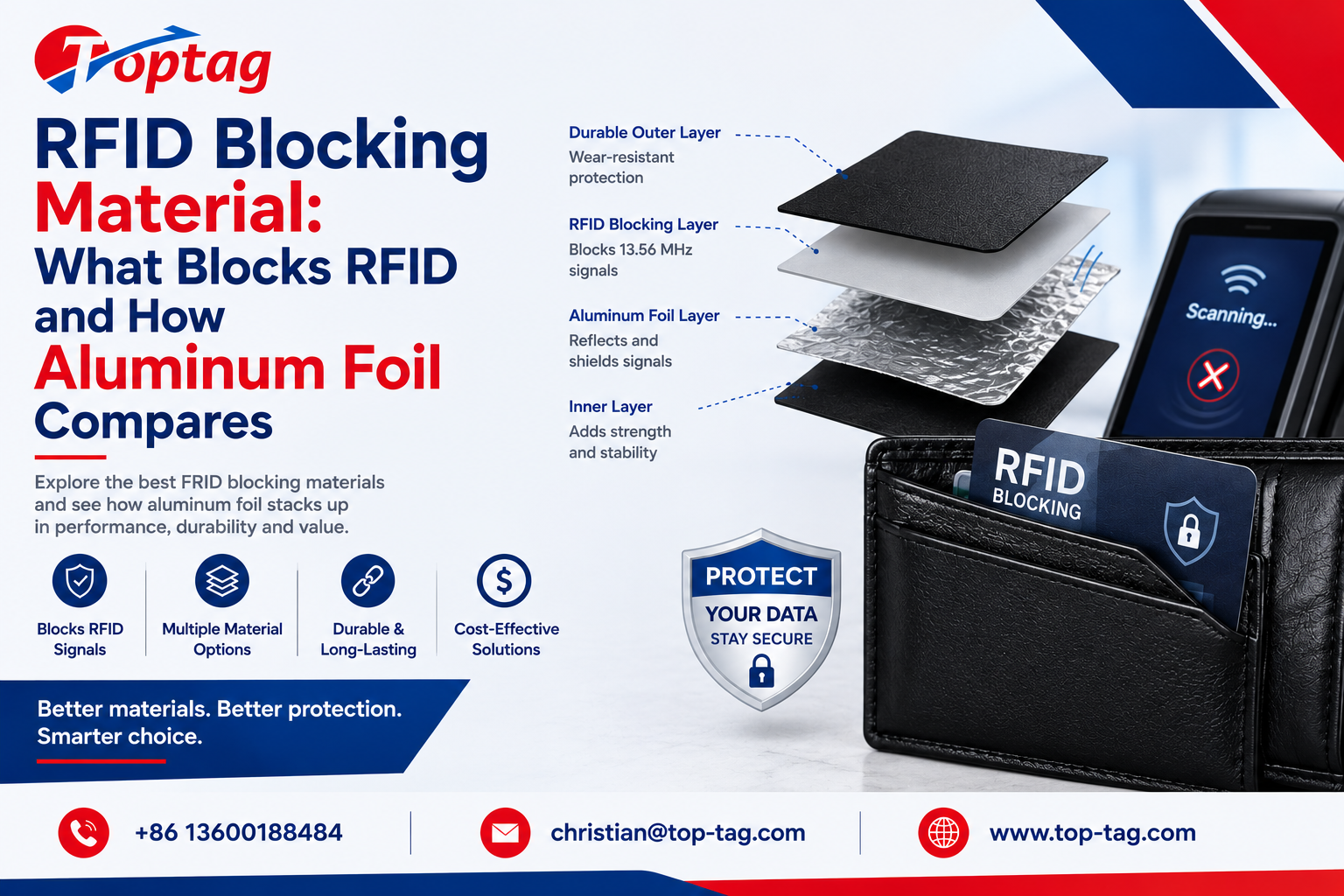
RFID Blocking Material: What Blocks RFID and How Aluminum Foil Compares
RFID signals are radio waves, and some materials stop radio waves better than others. That's the principle behind every RFID blocking wallet, sleeve, and card. Conductive materials, especially metals, can absorb or reflect the signal so a reader can't power or talk to a chip inside. Understanding which materials work, why, and where they fall short helps you judge products, and even a few do-it-yourself ideas, with realistic expectations.
This guide explains how RFID blocking materials work, which materials block RFID, how aluminum foil compares, and what to check when buying blocking products.
The Basic Science
A passive RFID chip has no battery. It gets power from the reader's radio signal, then replies. To block it, you need to stop that signal reaching the chip, or stop the reply reaching the reader.
A closed conductive enclosure does this. Radio waves induce currents in the conductive surface, and those currents cancel the field inside. This idea is often called a Faraday cage. It works best when the enclosure is complete, with no large gaps compared with the signal's wavelength.
That's the key point: coverage matters as much as material. A thick sheet of metal with a big hole in it will leak signal.
Materials That Block RFID
Several conductive materials are used in blocking products.
Aluminium foil layers are common in cards, sleeves, and wallet linings. They're cheap, light, and effective when the cover is complete.
Metallized films have a very thin metal coating on plastic. They're flexible and thin, which suits cards and sleeves.
Conductive fabrics are woven or coated with metals such as copper, nickel, or silver. They're used in bags, pouches, and wallet linings because they flex and don't crack like foil.
Nickel and copper foils or meshes offer strong shielding and durability, and appear in higher-quality products.
Metal tins and cases work as full enclosures. A closed metal tin can block signals very well, though it isn't practical for everyday wallets.
Materials that don't block much include ordinary plastic, leather, paper, and most fabrics. They let radio waves through, which is why a card in a normal wallet reads fine.
Does Aluminum Foil Block RFID?
For foil to work, it needs to wrap the card fully, with overlapping edges and no open gaps. A card wrapped in several layers of intact foil often becomes unreadable by an ordinary contactless reader. A card with foil on one side only, or a gap where a corner is exposed, may still read.
Practical problems include:
Foil tears and crumples easily, creating gaps over time.
It's awkward to remove and re-wrap a card every time you want to use it.
Thin kitchen foil varies in quality, and results differ from one product to another.
Foil doesn't stay neat in a wallet.
So foil is a decent experiment and a reasonable emergency measure, but it's not a comfortable everyday solution. Purpose-made materials are more reliable and easier to live with.
How to Test a Material
You can compare materials safely at home using your own cards.
Place a contactless card in the material or enclosure.
Hold it near an NFC-enabled phone or a reader you're allowed to use.
Check whether the card is detected.
If the phone detects nothing with the card enclosed, the material is blocking that frequency. Test several angles and edges, because leaks often appear at corners and seams. This is a simple check, not lab certification.
Frequency and Material Performance
Blocking performance can vary by frequency. Most contactless bank cards use 13.56 MHz, many older access cards use 125 kHz, and long range tags use UHF. A well-built shield may work across several of them, but results differ by material and design. This is why a product should state which frequencies it covers and how it was tested.
What to Check When Buying Blocking Products
Which frequencies it covers.
How it was tested, and whether the seller can explain the method.
How complete the coverage is. Full enclosures beat partial ones.
Durability. Materials should survive bending, sweat, and everyday use.
Thickness and flexibility. Thin, flexible layers suit cards and wallets.
Honest claims. Be cautious of promises of total protection.
Do You Really Need Blocking Material?
Real-world skimming of modern contactless payment cards is uncommon, and those cards have extra protections. Blocking material still makes sense for access badges and ID cards with fixed numbers, and for people who simply want peace of mind. Treat it as one layer, alongside normal banking habits.
Blocking Materials in Custom Products
Businesses sometimes use blocking materials in branded wallets, card holders, pouches, and cards. If you're ordering custom items, ask the supplier which materials are used, whether they can supply test information, what printing options exist, and whether samples are available before bulk orders.
Why Consider Top Tag?
If you're looking for RFID blocking cards or products made with shielding materials, Top Tag is worth adding to your shortlist. Tell them which frequencies you need to cover, what product format you want, and your quantity, and ask for samples so you can test the shielding yourself.
As with any supplier, confirm specifications and testing details in writing.
Frequently Asked Questions
What materials block RFID signals?
Conductive materials such as aluminum, copper, nickel, and metallized fabrics or films, when they enclose the item properly.
Does aluminum foil block RFID?
Often yes, if it fully wraps the card with overlapping seams. Gaps and tears let signals through.
Does leather or plastic block RFID?
No. They let radio waves pass.
Can one material block every RFID frequency?
Not always. Performance varies by frequency and construction, so check the specs.
Is DIY shielding as good as a purpose made product?
It can work in tests, but it's less reliable and less convenient for daily use.