
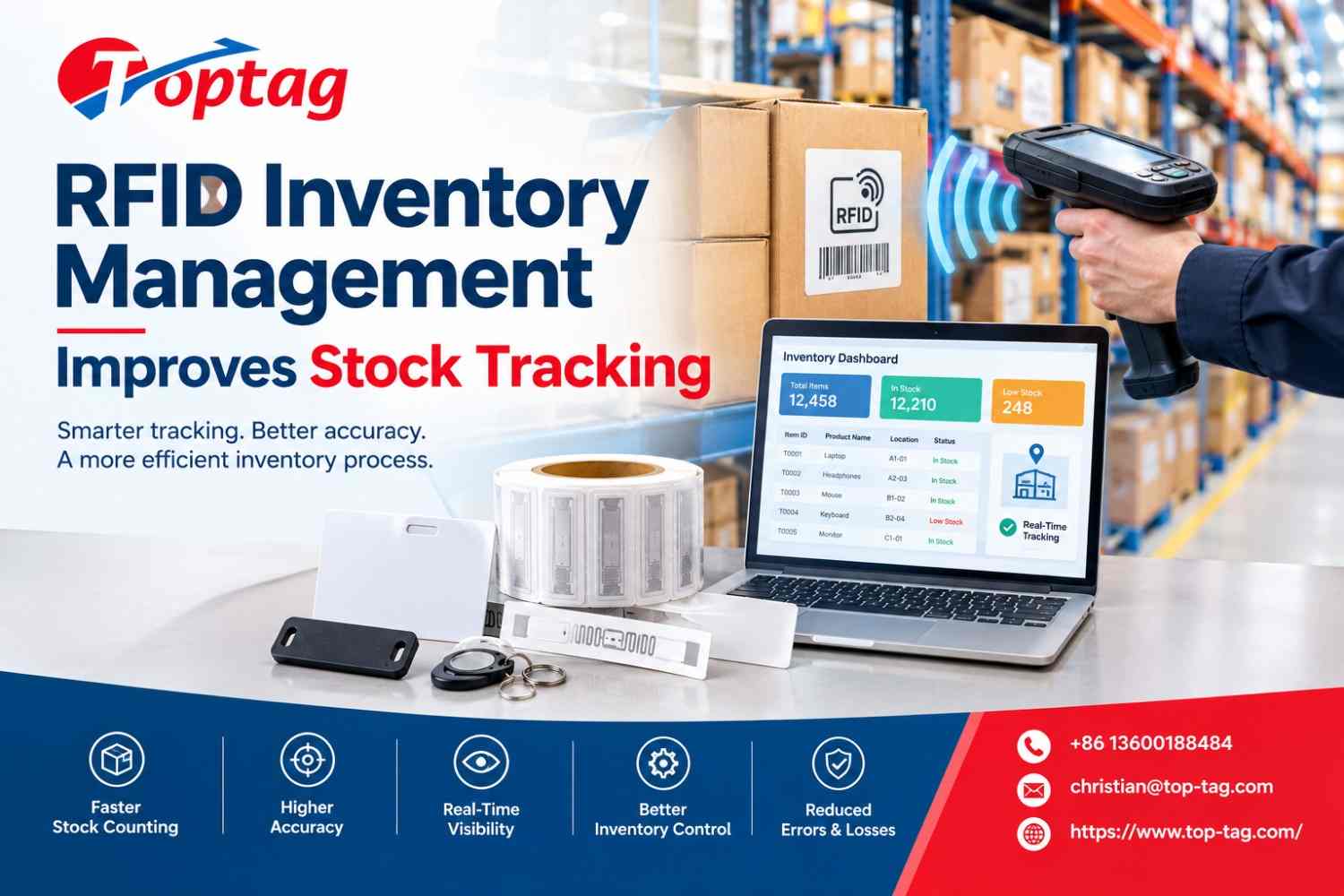
How RFID Inventory Management Improves Stock Tracking
Manual counting of stock is a process used by many firms even today. The process takes a long time, goods are sometimes lost, and the numbers do not always tally with what is written in the books. RFID Inventory Management provides a more efficient means for firms to assess their stock levels. Tags attached to goods transmit signals to readers, hence allowing firms to locate and count goods quickly. The above method of RFID Inventory Tracking is both simple and effective. This guide aims to help you understand it.
What Is RFID Inventory Management?
RFID inventory management is defined as the use of radio tags, readers, and software to monitor inventory. The items have radio tags with unique numbers. The readers read the numbers, while the software identifies the number with the item and its location. In this way, the components make an RFID inventory management system. It is used to identify the products and record when the items are received, moved, or left. Depending on the type of system, it reduces the need to scan individual items since many tags can be scanned at once. A small business starts with a single reader and a few hundred tags, while a big company requires many readers in different locations.
How RFID Inventory Management Improves Stock Tracking
The tag information is collected by the readers located at the doorways, shelves, or even held by the personnel. The software automatically updates the stock record. It allows the team to see the exact location and number of the item, supporting Real-Time Inventory Tracking. It is very beneficial for RFID inventory management as the stock record stays close to the real number of items on the shelf. The effectiveness of RFID inventory tracking depends on planning. The outcome is determined by the location of the tags, the coverage area of the readers, the material of the item, and the configuration of the system. With RFID Stock Management, stock records can be updated instantly without waiting for the month-end count.
Key Components of an RFID Stock Tracking System
RFID Tags: Contain the identity associated with each item. There are labels, stickers and sturdy RFID Tags for Inventory available.
RFID Readers: Read the compatible tags within their reading range.
Antennas: Transmit and receive the signal in systems requiring separate antennas.
RFID Inventory Software: Processes the collected information and maintains the inventory records.
All these parts function as a single unit. The tags contain the identity, the readers read it, the antennas facilitate the transmission of the signal, and the software converts it into inventory records. Compatibility is important rather than being expensive.
Benefits of RFID for Inventory Tracking
Counting at faster speeds in suitable environments
More insight into the flow of stock
Reduced manual data input
Easy identification of stock discrepancies
Improved planning and restocking
RFID Inventory Management that performs better will reduce any surprises, while automated inventory management reduces the need to repeatedly count stock. Effective RFID Inventory Management provides all these benefits to all your stock. RFID Inventory Accuracy depends on the way the system is configured and its requirements.
Applications of RFID Inventory Management
Warehouse: Monitor products that are incoming, outgoing, and in storage.
Retail store: Monitor product availability and flow of stock.
Manufacturing: Monitor raw materials, components, and finished products.
Logistics: Increase visibility in handling and shipping.
Healthcare: Monitor qualified equipment and supplies.
With RFID Stock Management, a shop, for instance, may be able to scan all the clothing on a rack in just seconds instead of folding and counting them individually. In all these areas, RFID Inventory Management assists the team in knowing what they have and where it is located. Efficient RFID chip barcode inventory management also assists in better planning of orders.
RFID Inventory Tracking vs. Barcode Tracking
The systems perform the same job differently. Scanning for a single code is mandatory using barcodes, but multiple codes can be detected by RFID simultaneously. RFID label tracking may involve more costly equipment and higher set-up costs as compared to barcodes, and require an appropriate installation. Barcoding might be used for easy tasks where low costs matter, while RFID may work better for tasks where batch scanning is needed. The best system for managing the stock will be determined by the volume of the stock and budget available. Most teams consider barcodes and RFID Inventory Management together when making their choice.
How to Implement RFID Inventory Management
Define your objectives and identify issues associated with the inventory process.
Select appropriate RFID tags and RFID readers.
Ensure their compatibility with your existing inventory software.
Conduct testing of tag reading and reader coverage within the actual space.
Train your employees and define easy-to-follow procedures for checking stock records.
Evaluate the performance of the system and make any necessary adjustments. Begin with a small area and use the experience gained to gradually expand the system.
Following this process allows you to develop an RFID inventory system that is well-suited to your facility. This process also provides you with increased RFID inventory control since any problems will become apparent at an early stage.
Frequently Asked Questions
1. How does RFID improve stock tracking?
Readers capture tag data, and the software uses it to update inventory records. This helps stock records stay closer to what is on the shelf.
2. Can RFID track multiple inventory items at once?
Yes. Compatible readers can detect many tags in range, depending on conditions.
3. Is RFID better than barcode tracking?
It depends on your budget, workflow, and tracking needs. Barcodes suit simple jobs, while RFID suits bulk reading.
4. What equipment is needed for RFID inventory management?
You need RFID tags, compatible readers, inventory software, and antennas where required.
5. Does RFID provide real-time inventory tracking?
Near-real-time updates are possible when the system is set up to capture and process tag data well.
Conclusion
Stock issues usually cannot resolve themselves, but with the proper resources, they will be much easier to tackle. The solution lies within RFID Inventory Management, which allows your team to view its stock and locate it fast without any time wasted on slow manual inventorying. Optimal outcomes can be achieved by implementing an effective plan. Begin by identifying your objectives, then choose tags, readers, and software that match your particular stock and location. Always test them within your own premises first, before implementing the system. TopTag provides tags, labels, cards, wristbands, readers and antennas, allowing you to study all of the RFID products in one place. Make a brief review, ask yourself questions, and decide wisely.