
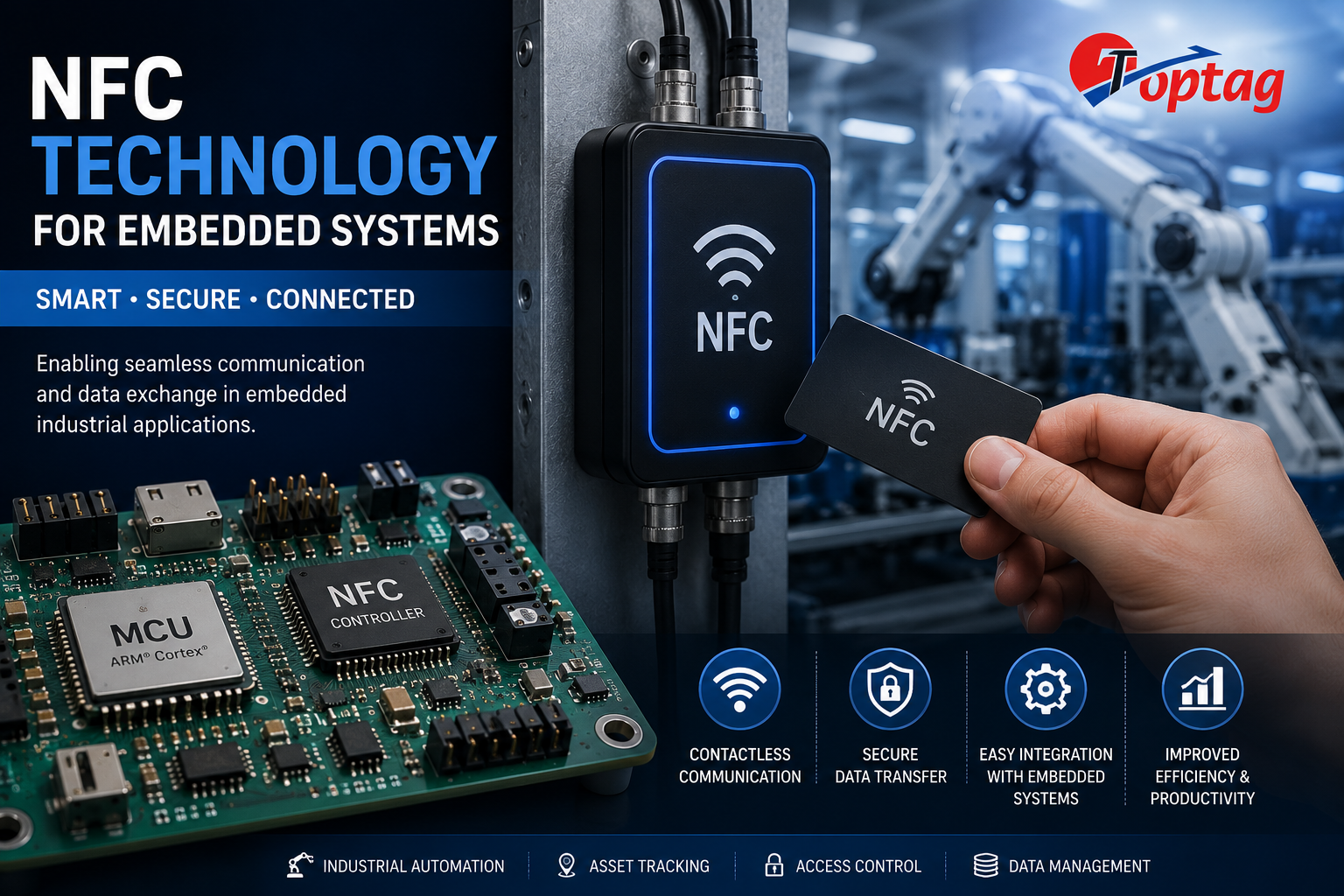
NFC Technology in Embedded Systems: Applications, Design, and Implementation
Near Field Communication (NFC) is a short-range wireless communication technology that operates at 13.56MHz and has become an important part of embedded system development. Due to its physical-layer security, low power consumption, and reliable communication, NFC is widely used in industrial applications such as intelligent manufacturing, industrial asset management, embedded security systems, and equipment maintenance. By following international standards such as ISO/IEC 14443 and ISO/IEC 18092, NFC enables secure and efficient communication between embedded devices and NFC tags. This article discusses the core application scenarios of NFC technology, the key design considerations for industrial NFC card readers, protocol optimization methods, and practical implementation guidelines for embedded industrial equipment.
Core Application Scenarios and Typical Cases
With the physical-layer security features of 13.56MHz near-field communication, NFC technology has been widely applied in embedded industrial scenarios. Here are several typical high-value cases.Full-Process Control in Industrial Intelligent Manufacturing
Automobile parts enterprises deploy NTAG series NFC tags on workpiece pallets. The fixed card reader beside the production line can complete the batch identification of 40 tool electrodes within one second, reducing the equipment mold-changing time from 90 minutes to 12 minutes, increasing the data collection efficiency by three times, and reducing the error rate by 90%. In intelligent warehousing scenarios, when a forklift passes through the reader area, it can automatically upload the information of the whole pallet of goods, saving 70% of the inventory time. For goods such as metal cans and oil drums that are difficult to identify with traditional RFID, the anti-interference feature of NFC enables "traceability of every item" in material tracing.
Low-Cost Embedded Security Storage System
Based on the solution of Renesas RA2E1 MCU + PTX105R NFC card reader, only by reading the globally unique UID of the ISO14443 Type A tag and comparing it with the pre-stored legal UID can access to the encrypted data in the MCU's built-in Data Flash be allowed, realizing low-cost physical access control. This solution is suitable for local permission verification scenarios of industrial equipment.
Full-Life-Cycle Management of Industrial Assets
Schneider Electric deploys NFC tags on the surface of substation equipment. Engineers can retrieve maintenance manuals and historical repair records by simply touching them with a handheld terminal, reducing the on-site query time by 70%. Bosch's automotive diagnostic tools read vehicle fault codes through NFC, increasing repair efficiency by 50%, while the asset positioning error rate is less than 0.01 ppm.
Key Design Points of the Core of NFC Card Readers Under ISO Standards
Mainstream industrial-grade NFC card readers follow two core standards:
ISO/IEC 14443 (Near-field card communication)
ISO/IEC 18092 (NFC general protocol)
The following aspects should be emphasized during design.
Radio-Frequency Architecture Hardware Design
The typical system link is:
MCU ← SPI/I²C → NFC Controller ← Impedance Matching Network → Antenna Coil
The key design points include:
The carrier is strictly locked at 13.56MHz. The LC resonant circuit filters out high-order harmonics, improving transmission efficiency while reducing spurious radiation.
To solve the common metal interference problem in industrial scenarios, avoid placing the antenna in the center of the mainboard near the battery and shielding cover. Instead, use an FPC flexible antenna attached to the inner wall of the non-metal shell, which can restore the card-reading distance from less than 2 cm to more than 6 cm.
The receiving chain uses an envelope detection and low-rate ADC sampling scheme combined with FPGA digital signal processing, which accurately captures the 2–10% amplitude ASK modulation signal returned by the card. The 106 kbps communication rate defined by ISO14443A can be achieved without a high-speed radio-frequency front-end.
Compliance Design of the Protocol Layer
Strictly follow the anti-collision mechanism defined by the standard. Implement multi-card identification based on the UID binary tree algorithm. In dense scenarios, an enhanced strategy of briefly shutting down and restarting the radio-frequency field can be added to force all cards to resynchronize, greatly reducing the probability of missed reads.
Support multiple protocols simultaneously, including ISO14443 Type A, ISO14443 Type B, ISO15693, and Felica, to avoid compatibility issues with older customized access cards and special industrial tags.
During the mass-production stage, add an automatic calibration process. Use the MCU to drive a simple VNA module to scan the S11 parameters of each PCB and dynamically adjust the matching capacitance to ensure consistent card-reading performance across mass-produced products.
Practical Experience in Protocol Optimization in Industrial Scenarios
Low-Power Consumption Optimization
Use a highly integrated NFC controller such as the NXP PN7150, which integrates the radio-frequency front-end, protocol processor, and standardized NCI interface into a single chip. The MCU does not need to continuously run a complex protocol stack. It is awakened only by an interrupt when a card enters the field area, reducing standby power consumption to the microampere level and making it suitable for battery-powered industrial handheld terminals.
Enhancement of Security Mechanisms
In industrial-grade applications, AES-256 encryption and dynamic key exchange are integrated, reducing the information tampering rate to as low as 0.0001%. At the same time, the system is compatible with ordinary NFC mobile phones for emergency operations. Basic data can be read without dedicated equipment, greatly reducing the on-site deployment threshold.
Seamless Integration of Multiple Systems
Through standardized Modbus and OPC UA interfaces, the NFC card reader can connect directly to existing industrial systems such as PLC and MES. Without additional gateway development, real-time synchronization and uploading of process data can be achieved, meeting the digital transformation requirements of Industry 4.0.
Guide to Avoiding Pitfalls in the Implementation of Actual Industrial Equipment
Use Mature Development Resources
Avoid blindly pursuing self-developed full-protocol stacks. Prioritize mature driver libraries and reference designs provided by manufacturers such as Renesas and NXP. This can compress the prototype development cycle from months to weeks while avoiding extensive low-level radio-frequency debugging.
Select the Appropriate NFC Tags
When selecting tags, ensure the UID is static and non-rewritable, such as NTAG213, NTAG215, or NTAG216. Tags that support UID randomization can cause the authentication logic to fail completely.
Perform Environmental Stability Testing
After completing functional testing, supplement it with stability verification under high-temperature, low-temperature, humid, and strong electromagnetic interference environments. In industrial scenarios, EMI testing requires scanning the full frequency band using a spectrum analyzer to confirm there is no excessive spurious emission and to avoid interference with other industrial equipment on.
Conclusion
NFC technology has become an effective solution for embedded industrial applications by combining secure communication, reliable performance, and efficient system integration. Through proper hardware design, compliance with ISO standards, protocol optimization, and careful implementation, NFC card readers can provide stable performance in intelligent manufacturing, industrial security, asset management, and automation systems. By using mature development resources, selecting appropriate NFC tags, and performing comprehensive environmental testing, developers can improve system reliability while reducing development time and ensuring consistent performance in industrial environments.